Friday, March 31, 2017

Finished Script, onto filming!

I’m back! On Thursday, 2 of my group members and I met up to work on this script and we finished!! It came out well, but we want to find a way to make the ending more indicative of the purpose: criticizing the court system and its unfairness/ bias.

I'll copy only some of the script below because I don't want to give too much away:

Enrique: “Can we get back to the reason why I’m here?”

Interrogator: Watch your tone. In America, we respect authority.”

Mood changes from aggression to passive aggressive. (chuckles)

Interrogator: “So tell me, you haven’t been here in awhile…”

Enrique: “Yeah I’ve been trying to clean up”

Mark: “Face it, your people will always be criminals”

Basically, we really wanted the interrogator to be as mean and rude to the “criminal” as possible. The interrogator is symbolic of the court system and the justice system. The protagonist, Enrique, is symbolic of the hard-working, lower class minority who is trying to make a living and get by in America. At the end of the scene, we wanted Enrique to have his hands somewhat moving and the interrogator slap them down and shut them closed. This is symbolic of the court system shutting down minorities and being bias of them before actually knowing who they really are.  
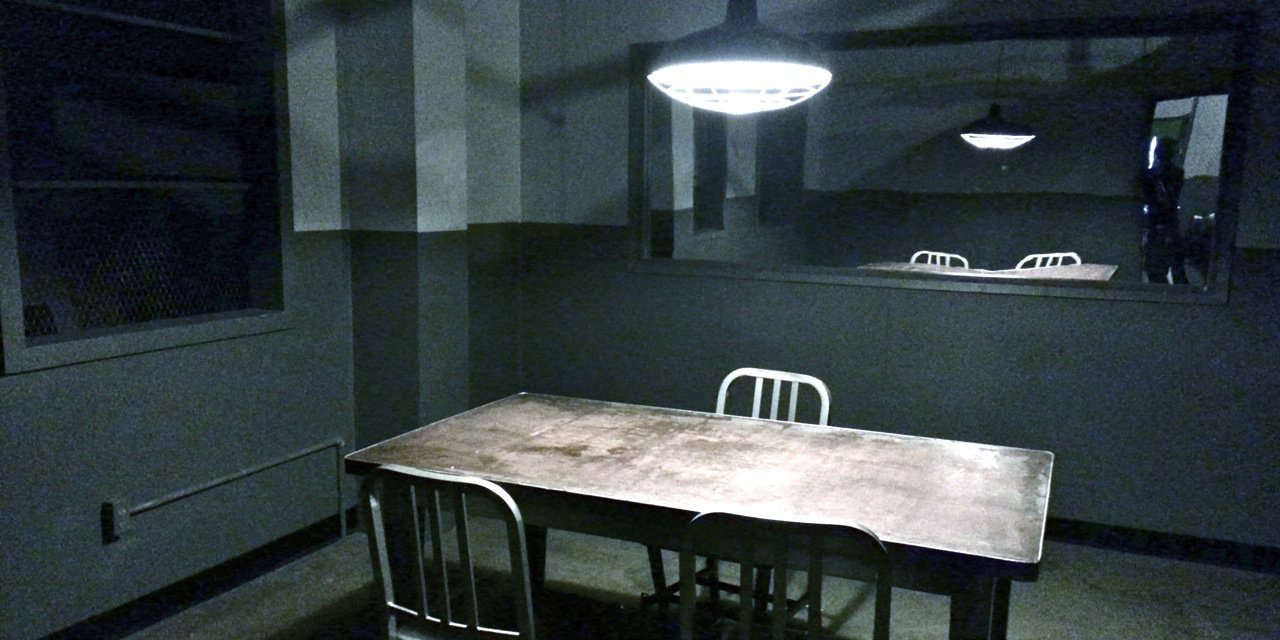
    We also looked at TV shows like Criminal Minds to get some inspiration. We looked at one scene in particular to show the characterization of the interrogator. He is slick, rude, and knows the type of information he’s looking for and will try to twist Enrique’s words to get him to confess to anything. Especially in this episode where the criminal says “so, you have no right to search me?” and the interrogator asks “why? What would we find?” is perfect for how we want our interrogator to come off as. He puts the criminal in an uncomfortable situation, trying to get him to break easily and confess to anything. This scene really helped us get a better understanding of how interrogators act, what they say, and how our actor should stand, walk, and position himself.

We also focused on the little things like slang words and context. We figured if our protagonist was to be lower class, he should talk like a lower class person and his dialogue shouldn’t be enriched in vocabulary, opposed to the interrogator's dialogue. This will also help the audience understand the differences between these two characters.

We’re waiting on our other group member to add her comments on the script, and help us finish with a stronger ending, and Sunday we film everything. I’m very excited, especially because our actors are going to be amazing in their roles and this is finally coming together quite nicely.

I’ll post more information and updates tomorrow.

Until then, keep watching!

References:

Spera, R. (Director). (2008, November 5). Criminal Minds [Video file]. Retrieved from https://www.youtube.com/watch?v=NM2f9nWb_GU

Sunday, March 26, 2017

Script 2.0

Hello, I’m back!

So it’s been a pretty busy and crazy weekend, with my group and I freaking out over the fact that none of us can agree on how to approach this project. I’m seriously considering on starting over, but I know we can’t do that.

The script is coming along, but one of my group members realized that I really can’t start the script until we know what we’re doing, so instead I laid out ideas for a script.

  • Start with him meeting up with his lawyer
  • File would be really big = troubled kid
  • Lawyer should probably be hypocritical/ unhelpful = shows injustice
  • Should we show the verdict?
  • Voice over of his thoughts (not main source of dialogue though)
  • Take place in a meeting room (we can kinda do one of those 12 Angry Men kind of scenes)

That’s all I can come up with for right now, and hopefully our actors can deliver the performance. On Friday we’re playing to shoot, since our schedule got pushed back, and by Wednesday everything: The storyboard, shot list, script, character development, actors, etc., will be done

Well… Until then, keep watching!

Friday, March 24, 2017


Script

Hey guys! So yesterday my group members and I met up and we started to discuss the different feedback each section gave us for the project.

Most of the feedback we received dealt with the first 30 seconds of our opening. Most of the people liked the idea of going against the court system, but they agreed that we should probably start with a meeting between the main character and his lawyer, or something more visually pleasing than a dark interrogation room or cell. They also mentioned that if we want this project to work, our actor should be picked so it is clear that he’s a minority. We realized that we have the “meat” of the project done, like our overall plot and what we need (prop-wise) to get it done, but when it comes down to how to start and end the scene, we’re hopelessly lost.

One of my group members thought that to make it easier and save time, each person should be assigned a job. These jobs will help us develop our opening and hopefully reach a mutual understanding of how we want it to start and end. Maria and Jenna are going to collaboratively work on the storyboard, where Maria will draw and Jenna will write down the shot/ angle composition for each scene. Kaelin is going to start on character development, because we realized that we should have an idea of how our movie will end even if we are only showing the opening scene. Lastly, I am working on the script.

When working on the script, I turned to different types of films for inspiration to get a better idea of what terms or vocabulary I should be using.

For example, A Few Good Men, and in ...And Justice for All  has perfect representation of the court system, it's corruption, the terms used in a court of law, and how a court system operates. I didn't watch all 2 hours of these movies, but for the first 30-45 minutes of these films (especially the court scenes) I noticed how each character was dressed, acted, where they stood, etc. Also, when spoken to they always refer to the Judge as “your honor,” and most times than not, the victim/ defendant is quiet and only their lawyers talk.

I was taking notes of these scenes to help me with the script. Most of my notes dealt with representation, the mise-en-scene and the lighting. I've noticed that when in court, most of the time, it's darker than when they step outside or are home somewhere far away from the courtroom. This probably is making a statement of how dark and corrupt they system is. My notes and watching videos has helped me with starting the script. I got to run it by my group to make sure they agree with me as well.

Until then, keep watching!

References:

Sorkin, A. (Director). (1992). A Few Good Men [Motion picture]. USA.

Jewison, N. (Director). (1979). ...And Justice For All [Motion picture]. USA.

Wednesday, March 22, 2017

Meetings

Hello everyone! So I completely forgot to post about this, but better late than never right?
On Tuesday, my group and I expected to meetup to discuss our plot, but instead my teacher came up with this brilliant idea that helped us out way more.

So basically this “meeting” exercise went down like this: one member from each group was placed into a “section,” so that way we were exposed to the different ideas other groups were coming up with. There were four different sections. Whoever was presenting their idea to their section, had to project their progress or any other information they thought would be helpful to the “observers” in order to explain what their project was and how they planned to accomplish this task. The “observers” then had the chance to provide feedback, commentary, ideas, questions, etc. to the presenter in order to help them with their project.

I LOOOOOOOVED THIS ACTIVITY SO MUCH!

It really helped me gain more ideas and insight to our project. After I presented my group’s progress, some of the comments my classmates made really made me think of a better idea of our plot and how I can approach the opening. Not only that, but some of the feedback other members received was helpful to me because I learned different ways to make a scene more interesting, leave it intriguing, or make it worthwhile even.

So you’re probably asking, “uhh that’s great and all, but what were some of the ideas that helped you?”
Good question. Well, after I finished presenting and showed them all my ideas about voice over and the different plans my group came up with to open the project, one girl asked, “That’s really good, but how are you going to make the audience want to keep on watching?” It hadn’t hit me until then that she was right! An opening is supposed to leave the audience wanting more. So with this activity, my section helped me come up with the following:

  • Look at 12 angry men, and Raising Arizona for inspiration
  • Maybe start with the character talking to the lawyer and use vague terms to make the audience think
  • Don’t rely too heavily on voice over
  • Have a strong opening line
  • If you want to criticize the court system, make sure you indicate somehow that it’s going to be about that
  • Interrogation or lawyer is the best way to go
  • Dramas focus a lot on music and editing so that’s important, as well as know your audience

All these tips really helped me to rethink our whole opening. I do agree definitely that editing and music should be a big part of it, and ambiguity is needed to leave the audience wanting more. Tomorrow, I’m meeting up with my members and we’re going to share our experiences and ideas with each other. I hope by tomorrow we have a set plot, and storyboard because I’m so ready to start filming. This activity made me even more excited about our project.

Well I’ll keep you updated and probably post tomorrow.

Until then, keep watching!

Sunday, March 19, 2017


Voice-overs!

Hello! A promised I have come back prepared to explain the different types of voice overs I think we should definitely consider using for our film opening.

The first movie I chose was Fear and Loathing in Las Vegas. This movie  relies heavily on the voice over as a way to carry out the story, and even says the same line as the character at times. Without the voice over, the whole story would probably be Raoul and Dr. Gonzo screaming the whole time. This movie, especially, uses voice overs to incorporate the character’s thoughts, actions, and motives to the audience and why they do or don’t do certain things. If we go this route for the film opening, relying heavily on voice over, then we have to make sure we time the scenes correctly with the character’s lines, and we have enough going on that a voice over is absolutely necessary. Using voice over to this extent may hurt our production so we have to make sure we edit the scenes well so it works.

The second example is from Fight Club. This movie doesn’t rely so much on voice over as Fear and Loathing in Las Vegas, but is still incorporated to explain to the audience how the character thinks, why he thinks that way, and what was going on in his head. This voice over is funnier and even freezes the scene to show that the events taking place on screen are in the past. Also unlike Fear and Loathing in Las Vegas, the voice over does not overlap with the character’s dialogue or explain what is going on in the scene. Instead, the voice over is used after the character is done talking and only describes what he’s thinking and what is going on in his mind at the moment. I think this type of voice over will be the one we end up choosing. Are voice over has to describe what our character was feeling, thinking, planning, and doing before and during the event. This voice over will help us not only develop our character, but our plot as well.

Lastly, the infamous Breakfast Club ending. This voice over is different from the others. Instead of describing the characters, it is at the end of the film. As seen, the teacher reads a note written from the students (i.e the Breakfast Club) and the contents of that note is the voice over. The voice over in this case is a way of explaining the ending, how each character was affected by the Saturday school, and shows the character development of each character. It won’t really add to our benefit to use this voice over since it normally shows character development and we shouldn’t really place character development at the beginning of the film.

Overall, looking at the different types of voice overs really helped me understand exactly what type of voice over I would like to see in the film and which one would fit best with our character. I think the 2nd example is the best because we can use it to describe what our character was thinking at that moment and how it affected him. Especially with our topic of injustice in the court system, explaining how something affected our character is an important element of the plot.

Hopefully my group members agree with me. I’ll keep you guys posted.

Until then, keep watching!

References:

Gilliam, T. (Director). (1998). Fear and Loathing in Las Vegas [Motion picture]. USA.

Fincher, D. (Director). (1999). Fight Club [Motion picture]. USA

Hughes, J. (Director). (1985). The Breakfast Club [Motion picture]. USA.

Saturday, March 18, 2017


Progress!

Hi! I’m so happy because my group and I have started to have some great ideas for the film. Not going to lie, I was a little worried with the timing and production of the piece, but I think we can really make this happen. Last time we met, we were discussing the main, overall concept of what we wanted to do. Yesterday in class we met again and we started planning our schedule - when we’re going to film, edit, blog, meet up, turn it in, etc.- and we discussed the storyboard more as well.

So far, one of my team members, and myself, is going to be out for a whole week, so we have to film next week to fit everyone’s schedule accordingly. On Wednesday, after school, we’re going to start recording - or that’s the plan so far. Our schedule is obviously subject to change, but with less than three weeks to have this project done, we need to start recording soon. So far are schedule is as follows:

3/21: Meet up with group - finished storyboard
3/22 : Start Filming
3/23: Meet up with group
3/25-26: Film
3/27: Meet with group - discuss techniques
3/29: Film
3/31- 4/2: Finish filming
4/4: Edit film
4/6: Edit Film
4/8: Turn in project

We agreed that are critical reflection would be on our own time, so we didn’t add it to our schedule.

When we started discussing the storyboard, one member thought of keeping the main character’s face hidden throughout the opening to add “suspense,” and even though I understand the message they are trying to convey, this might hurt us in the long run. Another member thought that a voiceover could help us and would tell the main character’s story perfectly. I agree with this member a lot, actually. I just came back from watching Beauty and the Beast, and I was seeing how the voice over really helped to clear up the plot and any “plot holes” that could’ve resulted. I thought of two ways we would use the voice over:
  1. As he is sitting in the police cell (present), the voice over would “reverse the clock” so we go back to the beginning and tell the story from a specific point in time.
  2. As he sits in the police car, his voice over is explaining his current situation and we only see snippets of his past - to add mystery to the story.
The third way is that we have no voice over and the audience is a third party to the movie. I think a voice over would benefit us and help fill in any missing holes for the production.

I’m going to start looking up films with voice-over openings actually and post about my findings tomorrow.

Until then, keep watching!

Friday, March 17, 2017


Ideas? Send help

Hi again! So on Monday, my group members and I met up to discuss our project in class. The goal we set for ourselves was to have a basic plot going for our project. At first it was pretty difficult to come up with an idea all four of us liked. It got to a point where I for sure thought we were not going to get an idea by the end of the day. We started looking at the list of genres and finding information on which ones were the most successful over the last couple of years, using my previous websites.

After talking it through for about half an hour, we came to the conclusion that we wanted our film to stand for something we all thought was relevant and important. Something that is happening a lot regarding the politics of this nation. We wanted to make a statement about the court system of America.

After reading books like The Stranger by Albert Camus this year in my english literature class, and hearing about countless stories where many innocent people were convicted of crimes they didn’t do, we figured it was the best way to go for inspiration to create our film opening. The only problem we had left, now that we had our main idea, was to think of a plot and create a storyboard.

After about an hour or so, we got it down to a rough draft of what are character is going to be like and what the problem will be. We figured that the main character would be a male who has had a troubled past, meaning he has been arrested before. This time, he was getting arrested for a crime he did not commit and was being tried for it. We would explain his situation, his side of the story to show how he’s innocent, but at the end have him be found “guilty.” We still have to figure out the storyboard, shots, what we want the character to say, if it will be a voice over or not, and a lot of other details, but for now we accomplished our task of having a main idea for the story. Phew!

I’ll post later to keep you guys updated on are next steps.

Until then, keep watching!
References:

(n.d.). Retrieved from https://en.wikipedia.org/wiki/Drama_(film_and_television